
What a Garage Door Photo Eye Sensor Does — And Why It Matters
Garage door photo eye sensor what it does is simple to explain: it creates an invisible infrared beam across the bottom of your garage door opening, and if anything breaks that beam while the door is closing, the system instantly reverses the door to prevent injury or damage.
Here’s a quick breakdown:
- Detects obstructions — people, pets, cars, or objects in the door’s path
- Reverses the door automatically — the moment the beam is interrupted during closing
- Consists of two units — a transmitter (sender) on one side and a receiver on the other
- Mounted 4–6 inches above the ground — low enough to detect small children and pets
- Legally required — federal law UL 325 has mandated these sensors on all residential garage door openers since 1993
Most garage doors weigh at least 500 pounds. Without a working photo eye sensor, that weight can come down on whatever is in its path. These small devices are the last line of defense between a routine garage door close and a serious accident.
If your garage door is reversing for no obvious reason, or refusing to close at all, there’s a good chance your photo eye sensors are involved — either through misalignment, dirty lenses, or a wiring issue.
This guide covers everything Virginia homeowners need to know: how the sensors work, what can go wrong, how to troubleshoot them, and when to call a professional.
Understanding the Garage Door Photo Eye Sensor What It Does
To understand garage door photo eye sensor what it does, you have to look at it as a high-tech “eyes” system for your garage door opener. While the motor provides the muscle to move the door, the photo eyes provide the vision to ensure it’s safe to do so.
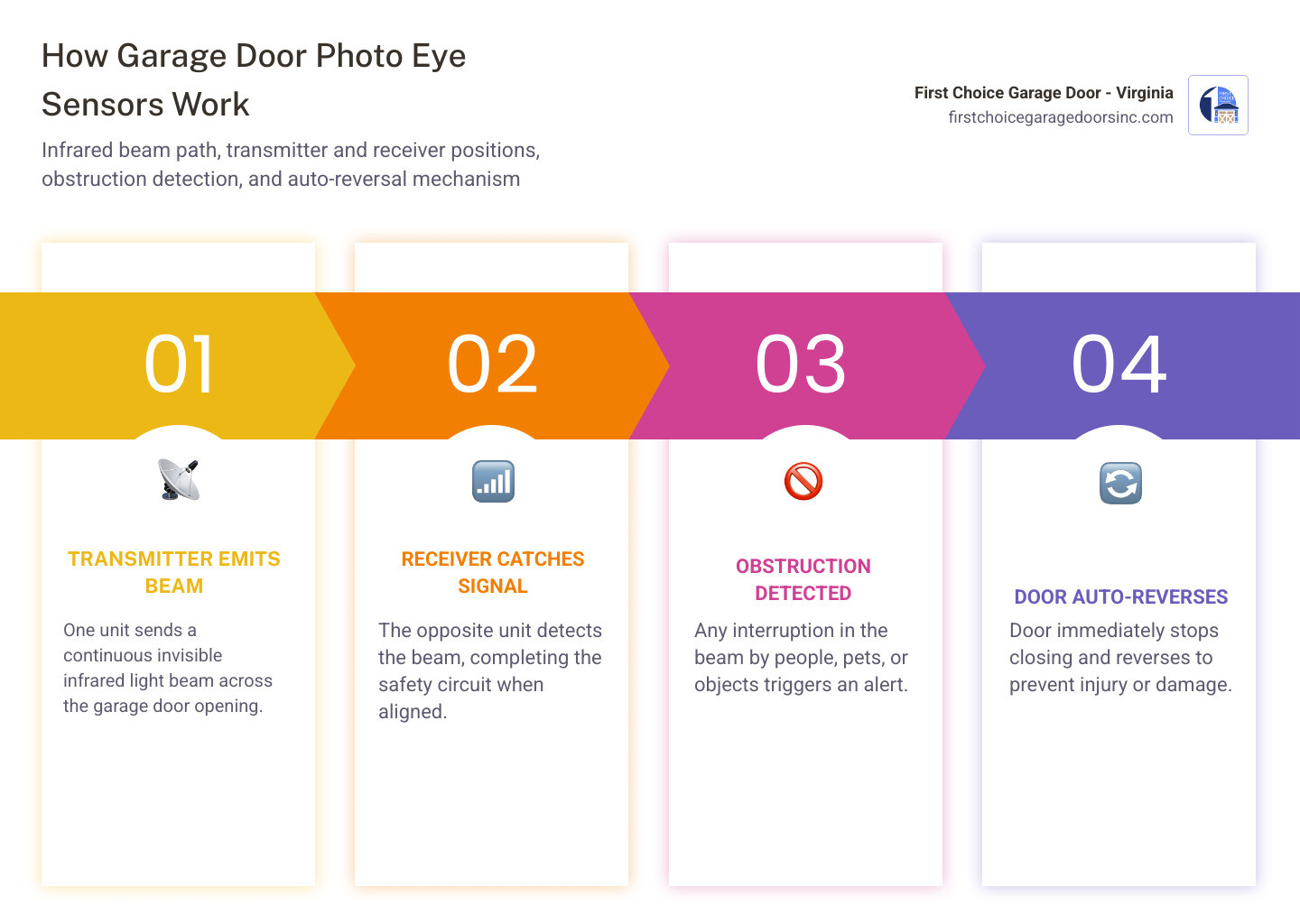
The system consists of two small units mounted on either side of the garage door track. One unit is the transmitter (the sender), which emits a continuous, invisible infrared light beam. The other unit is the receiver, which is designed to “catch” that beam. As long as the receiver sees the light from the transmitter, the circuit is complete, and the door is allowed to close.
The moment an object—be it a child’s foot, a pet, or the bumper of your car—steps into that path, the beam is broken. The receiver immediately loses the signal and sends an electrical pulse to the opener’s logic board, shouting “Stop!” The door then halts its descent and reverses back to the fully open position. This is a critical part of Safety Measures To Take With An Automated Garage Door, ensuring that your home’s largest moving part doesn’t become a hazard.
The Safety Mechanism: Garage Door Photo Eye Sensor What It Does
Think of the photo eye sensor as an invisible tripwire. Because most residential garage doors weigh between 150 and 500 pounds, they possess enough force to cause devastating entrapment injuries. Before these sensors were common, a closing door could exert over 150 pounds of pressure before the motor’s internal “resistance” sensor would kick in.
By using light instead of physical contact, the photo eye prevents the door from ever touching the obstruction in the first place. This is especially vital for Garage Door Safety Tips To Teach Your Kids, as children often try to “beat the door” by running under it while it’s closing. The photo eyes ensure that even if a child trips or stops in the doorway, the door will never make contact with them.
Why Federal Law Mandates These Sensors
Safety isn’t just a good idea; it’s the law. In 1990, the Consumer Product Safety Improvement Act was passed, and by 1993, the federal standard known as UL 325 became effective in the United States. This standard requires all residential garage door openers to be equipped with a secondary safety reversal system, which is almost always a pair of photo eye sensors.
This mandate was a response to thousands of injuries and several tragic deaths involving garage doors that failed to reverse. Today, it is illegal for a professional garage door company to install an opener that does not have functional safety sensors. If you have an older opener (pre-1993) that lacks these sensors, we highly recommend upgrading to a modern system to protect your family and stay compliant with 3 Garage Door Safety Tips that every homeowner should follow.
Proper Installation Standards for Northern Virginia Homeowners
In Manassas and throughout Northern Virginia, we see many “DIY” sensor installations that don’t quite meet safety standards. For the garage door photo eye sensor what it does to be effective, it must be installed with precision.
| Feature | Correct Installation | Incorrect Installation |
|---|---|---|
| Height | 4 to 6 inches from the floor | Higher than 6 inches |
| Alignment | Perfectly horizontal and facing each other | Tilted up, down, or angled away |
| Mounting | Securely fastened to the track or wall | Hanging by wires or loose brackets |
| Visibility | Clear path between sensors | Blocked by trash cans, tools, or cobwebs |
The “6-inch rule” is the most important standard. If the sensors are mounted too high, a small pet or a crawling toddler could pass underneath the beam without triggering the safety reversal. By keeping them low, you ensure that even the smallest obstacles are detected. Following these 5 Garage Door Safety Tips helps maintain a safe environment for everyone in your household.
Troubleshooting the Garage Door Photo Eye Sensor What It Does
Is your garage door acting up? If the door starts to close but then reverses and the opener lights flash, the sensors are the prime suspect. Here is how to troubleshoot the garage door photo eye sensor what it does when it stops working.
Decoding the LED Indicator Lights
Almost every sensor kit features small LED lights that tell you exactly what is wrong.
- Solid Amber/Orange Light: This is usually the “Sender.” A solid light means it has power.
- Solid Green Light: This is the “Receiver.” A solid green light means it is perfectly aligned with the sender.
- Flickering or Off: If the green light is flickering, the sensors are slightly out of alignment. If it’s completely off, the beam is either blocked, the sensors are totally misaligned, or there is a power issue.
For more detailed help on fixing these common glitches, check out The Easton Guide To Fixing Garage Door Sensors And Tracks.
Common Environmental Obstructions
Sometimes the problem isn’t mechanical—it’s environmental.
- Dirt and Cobwebs: Since sensors are near the floor, they attract dust, spider webs, and even “stinkbugs” in Virginia. A simple wipe with a dry cloth often fixes the problem.
- Sunlight Interference: At certain times of the day, direct sunlight can “blind” the receiver unit, making it think the beam is broken. You can fix this by swapping the sender and receiver units (so the receiver is in the shade) or by creating a small “sun shield” out of cardboard.
- Physical Obstructions: We often find that a stray leaf, a trash can handle, or a bicycle tire is just barely clipping the beam path.
Keeping the area clear is a top priority among Garage Door Safety Tips For Pet Owners, as pets often knock sensors out of place or leave toys in the beam’s path.
Identifying Damaged Sensor Wiring
If the LED lights are completely dark on both sensors, you might have a wiring problem. These are low-voltage wires that run from the sensors up the tracks to the motor unit.
- Staple Damage: Sometimes the staples used to secure the wire are driven in too hard, pinching the wire and causing a short.
- Moisture and Corrosion: In humid Northern Virginia summers, moisture can get into the wire connections and cause corrosion.
- Pets and Pests: We’ve seen many cases where a dog has chewed the wire or a mouse has gnawed through the insulation.
If you find a break in the wire, it can often be stripped and reconnected with electrical tape, but if the wire is damaged right where it enters the sealed sensor housing, the entire unit will likely need to be replaced. This is a key step in Garage Door Safety Tips To Follow to ensure your system remains reliable.
Maintenance and Testing for Peak Performance
You shouldn’t wait for your door to malfunction to check your sensors. We recommend a “Safety Test” at least twice a year.
The Cardboard Box Test:
- Open your garage door fully.
- Place a cardboard box (at least 6 inches tall) in the center of the door’s path.
- Press the button to close the door.
- The door should touch the box and reverse, or—if the photo eyes are working perfectly—it should detect the box and reverse before touching it.
Standard photo eyes typically last between 10 to 15 years. Over time, the internal electronics can wear out, or the lenses can become permanently scratched and cloudy. Regular maintenance, like cleaning the lenses with a microfiber cloth and checking the bracket tightness, can extend this lifespan. For a complete safety checklist, refer to Garage Door Safety Tips To Follow.
Frequently Asked Questions about Photo Eye Sensors
Can I bypass my garage door sensors if they fail?
You should never permanently bypass or disable your safety sensors. It is a massive safety gamble and a violation of federal law. However, if you are in an emergency and need to close the door (for example, if you’re leaving for work and the door won’t stay down), most openers allow a temporary manual override. You can usually do this by pressing and holding the wall button constantly until the door is fully closed. If you let go before it hits the floor, it will reverse. This should only be used as a temporary fix until a professional can arrive.
Are photo eye sensors interchangeable between brands?
Not always. While there are “universal” sensor kits available, they don’t work with every motor. Different brands like LiftMaster, Chamberlain, and Genie use different voltages and communication protocols. It is always best to use the specific sensors designed by your opener’s manufacturer to ensure the safety circuit works correctly.
How often should I clean my garage door sensors?
We suggest a quick wipe-down every six months. If you live in a particularly dusty area or near a gravel road in Northern Virginia, you might want to do it quarterly. Clear lenses are essential for a strong infrared connection.
Conclusion
The garage door photo eye sensor what it does is serve as the silent guardian of your home. From preventing property damage to saving lives, these small devices are the most important safety feature in your garage. Whether it’s a simple alignment issue or a more complex wiring fault, keeping these sensors in top shape is non-negotiable for a safe home.
At First Choice Garage Doors, we pride ourselves on being the local experts for Manassas and the surrounding Northern Virginia area. We don’t just fix doors; we ensure that every safety mechanism is calibrated to protect your family and pets. If your sensors are blinking, your door is reversing, or you simply want a professional to perform a comprehensive safety inspection, we are here to help.
Keep your home safe and your door running smoothly. For expert assistance with your system, learn more about our Garage Door Maintenance services today. We are committed to providing prompt, professional, and stress-free service to our neighbors throughout Northern Virginia.